
What is the best soldering iron temperature?
I mostly set my soldering station temperature to 320 degrees Centigrade. This is a good temperature for me for most soldering however, it may not be for you and you will need to change it for different situations. This guide will explain why.
Tip
Don’t just set the temperature and forget it. Experiment, and you’ll find the best setting for you and how you solder.
How hot does a soldering iron get?
A soldering iron can reach temperatures of up to 450C. A soldering station will give you the function of being able to set the temperature of the tip. This is usually between about 150C to 450C.
What temperature to set a soldering station?
This is a question that comes up a lot from beginners. Most seasoned users of solder stations or soldering irons that can alter their temperature don’t worry too much about the setting. It does seem a puzzle for those starting out.
This is probably because the answer is never really black and white. It does vary depending on the situation. The more you solder the more experience you’ll get. Mainly it will come down to the type of soldering you do and the soldering station or iron that you are using.
The main piece of advice I would give is that just turning the heat down on a soldering iron doesn’t mean that you have less chance of damaging components. That advice may seem contradictory.
Also, bear in mind that soldering produces a lot of smoke and fumes which can be harmful. Check out my guide on solder fume extractors and air purifiers.
Information
Where would electronics be without soldering? Unbelievably, the modern soldering iron was patented way back in 1896 by Richard Schneider and August Tinnerhol and was known as an “Electric heating apparatus”.
Temperature-controlled soldering stations
Some soldering stations and soldering irons are temperature-controlled. They sense the heat at the tip and regulate it appropriately. This is useful if you are making large solder joints where the heat from the tip gets reduced due to conduction.

Most of the cheaper solder stations have a control that is basically just like a dimmer for a light. They just increase or decrease the power. Although they may have temperature settings on the dial they won’t be accurate. The picture above shows a solder station that uses the “dimmer” method.
They do however still give you the ability to turn the temperature up or down which is all you really need as you get more experienced.
Knowing the exact temperature the tip is at doesn’t matter once you get the “feel” for the correct soldering temperature for a particular occasion.
What temperature does solder melt?
It depends on what type of solder. Have a look at my guide about the types of solder for electronics. Of the solder types that are intended for electronics, 60/40 starts to melt at 183C. When it gets to 190C it becomes a liquid. As it cools it becomes a semi-liquid until it cools to below 183C, when it will set.
The 63/37 solder will melt at 183C and become liquid almost immediately. It will start to harden up as soon as its temperature drops below 183C.
Lead-free solders melt at higher temperatures. Depending on exactly what type you use it could melt at 188C or as hot as 203C.
Soldering iron temperature set too low
It’s possible to have the temperature set too low to be able to melt the solder properly, no matter how long you hold the soldering iron tip on the joint. However, there could still be enough heat to damage electronic components.
As you can see from the above it’s possible to set your soldering station temperature too low. Not surprisingly it’s also possible to set it too high. It’s not just a case of setting it to the temperature that solder melts.
The correct soldering iron temperature
Your soldering iron isn’t going to be able to perfectly conduct the heat it produces. Heat will be conducted away once you touch it on the joint you are making. A small pad and a leg on an IC won’t lose as much heat as a large PCB power rail and a huge capacitor.
I set my soldering station temperature to 320C and that’s what I consider to be the best soldering iron temperature for circuit boards and small soldering. Anything bigger such as thick wires or screens on metal jack plugs and I put in a bigger tip and turn the temperature up to 370C. For tiny SMD soldering, I put in a small tip and dropped the temperature to 300C.
Soldering iron temperature set too high
Try not to get into the habit of having the temperature higher than you need. One of the first symptoms of using too high a heat setting that I became aware of was melting the insulation on thin wires.
Also the hotter your tip the faster it will oxidise and turn black. At too high a heat, the flux from the solder will burn off too quickly.
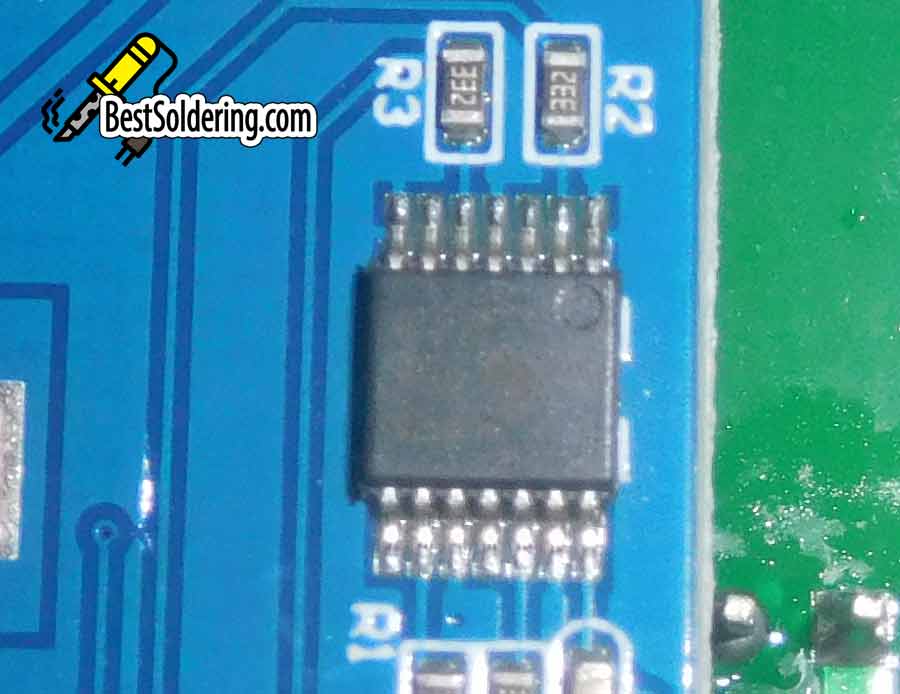
For small pads and SMD devices like in the picture above, you might be better off turning the heat down slightly.
I generally find 300 degrees centigrade better for small pads. That way you won’t risk overheating them and they won’t conduct much heat away from the iron. I also use extra flux.
Using flux for soldering
If there’s one piece of advice I would give, above all, it’s to use flux to help soldering.
Although solder for electronics already contains flux in its core, there are times when extra flux definitely helps. For larger joints, you need more heat and that may mean you burn off a lot of the flux in the solder.
Also, it makes SMD (surface mount devices) soldering so much easier. I wouldn’t even do SMD soldering without using extra flux. I use it from a tin. it costs less than £5 and will last for years.

Use the correct tip for your soldering job
Using the correct tip for a particular soldering job is just as important as getting the temperature right.
This is because a larger joint conducts heat away so just turning up the temperature isn’t the best idea. A small tip won’t be able to transfer the heat quickly enough to make a good solder joint.
If you are soldering wires thick wires to large connectors you will need a larger tip and to turn the heat up. If you are soldering small components or SMD components you will only need a fine tip.

The picture above shows a spade connector. this will conduct a lot of heat and so will the metal clip holding it.
I used a larger tip and turned the heat up to 350 degrees centigrade. You’ll also find that a helping hand makes jobs like this much easier and you won’t burn your fingers!

In the picture above, I’m soldering an SMD resistor. For this job, I used a fine bit and turned the heat down to 300 degrees centigrade.
Final thoughts
Once you start to use your soldering station you will become accustomed to how hot you need the temperature to be. There’s nothing like experience and you will know better than anyone what you need with your particular soldering station, tips, solder and the soldering you do.

Also, if you are more experienced, you probably solder joints more quickly than a beginner.
I used to work building circuit boards and most of us soldered very quickly. We got used to using higher temperatures to conduct the heat quicker and applied it for a shorter time than a hobbyist solderer would do.
For information on soldering, check out my article Learn how to solder – A beginners guide.
If you are looking for a new soldering station I have some recommendations here.
If you are looking to buy a new soldering iron check out my guide here.

“Hi, I’m Graham Moore and I’ve been building electronic projects since I was 12. I had a fascination for old radios and taking them to pieces but when my Nan bought me an electric soldering iron, I realised with a few components I could build stuff.
Learning to solder opened up many doors for me as electronics also became a career. I hope you get as much from it as i did”.
Hide Ads for Premium Members
[quads_disable_ads_form]
555 monostable calculator

555 monostable calculator Download the 555 monostable calculator to easily work out the time from the components. Once you have downloaded the spreadsheet, all you have to do is input…
555 astable calculator

555 astable calculator Click further down the page for a downloadable 555 astable calculator. If you’ve joined this guide from the 555 operating modes page or even if you haven’t,…
555 timer modes

555 timer modes The 555 timer has 3 main modes of operation. These three 555 timer modes are astable, monostable and bistable. You can achieve each of the modes by…
How to test a 555 timer

How to test a 555 timer This guide will show you how to test a 555 timer. I’ve covered testing many types of electronic components before and this tends to…
Capacitor value codes

Capacitor value codes Capacitor value codes are often used to indicate the value of a capacitor. Whereas resistors have usually stuck to a standard colour code (well standard-ish as it…
Lite windows with DAWs

Lite Windows with DAWs I wondered how much performance boost I’d get using Lite Windows with DAWs. The test results were shocking! A few years ago I decided to use…
How to connect Kodi to a network drive

How to connect Kodi to a network drive If you need to know how to connect Kodi to a network drive, it will depend on your particular network drive. I’m…
Can you solder without flux?

Can you solder without flux? The simple answer to can you solder without flux is no. The good news is that if you have got some solder it’s more than…