
What you should know about soldering iron tips
A soldering iron tip will eventually wear out and need replacing but if you look after it you’ll get a lot more use out of it then a badly looked after tip. Apart from saving money you’ll also get better solder joints and that’s what its all about after all.
Use good quality solder
A few years ago I needed to get a new reel of solder. The previous one was around half a kilo so had lasted a long while and I was amazed at how much solder had gone up in price on Amazon, so I decided to save some money by getting a bargain from eBay. After a few uses I noticed that the tip was getting dirty quickly. I tried some other solder and my suspicions were confirmed. The cheap solder probably had impurities and containments and so wasn’t a saving at all.
Read my article here on What’s the best solder for electronics?
I now stick to using decent solder. So make sure you use good quality solder. It now seems almost impossible to get solder that contains lead. I found that this melted better than the lead free alternative. I’ve also notice that it has more of a matt look than the shiny look a non lead solder joint had. In the old days a joint that wasn’t shiny could be the sign of a joint that wasn’t good and should be remade but I guess that its something I’ll just have to get used to with lead free solder.
Cleaning a soldering iron tip
Your soldering iron tip should always be kept clean. It doesn’t matter how good or expensive your soldering iron or soldering station is. If you try to use a dirty tip you wont get a very good soldering joint because you will introduce impurities into the joint and the heat won’t transfer very well. A dirty tip will also be a short lasting tip and you don’t want to keep having to replace them.
Don’t attempt to solder dirty printed circuit boards or dirty component leads as this will lead to a poor solder joint and get contaminants on to your tip. You can use alcohol to clean boards and component leads or very light abrasives.
In normal use you will have something to wipe your soldering iron tip on. Either a damp sponge or a brass tip cleaner. A damp sponge used to be all that was available but now you can get brass tip cleaners and I wouldn’t bother with damp sponges any more.
Brass tip cleaner
A sponge for tip cleaning has to be kept wet so every time you come to solder you’ll have the inconvenience of wetting it. Although it will clean your tip you’ll also shorten its life because a damp sponge cools the tip. The soldering iron then warms it up so its continually contracting and expanding and this doesn’t do it much good in terms of fatigue. I guess the soldering iron will also use more energy.

A brass tip cleaner is always ready to use. The brass is a soft metal so it wont damage the coating of the soldering iron tip. Its effectively just thin brass shavings making a wool type substance.
It doesn’t cool the soldering iron tip down when you wipe it on the brass shavings but it will remove the containments. Just use a gentle wiping motion and increase the pressure if it doesn’t appear bright and shiny after you’ve done this. Rotating it will make sure all sides of it get cleaned.
Once its clean apply some new solder to tin it. This will stop it oxidising.
I also apply solder to the tip prior to turning it off to minimise oxidising as it cools down. I also unscrew the barrel by half a turn so the tip doesn’t get jammed into the iron because of different temperature coefficients and contraction and expansion of the metals.
This should keep your tip clean as you routinely solder but if it becomes quite dirty or oxidised you can use cold tip polishing bars. But make sure the tip has completely cooled down, the clue is in the name “cold”.
These items are not as popular as they were but can still be found. Weller make one that available from component suppliers and Amazon. Just give the cold tip a light scrubbing with the bar and then tin it as soon as you heat it up again.
Tip temperature
Having the temperature of the soldering iron turned too high will also be detrimental to the life of the tip. I know personally as the temperature control on my soldering station accidentality got knocked to maximum without me realising until I noticed the tip had gone black.
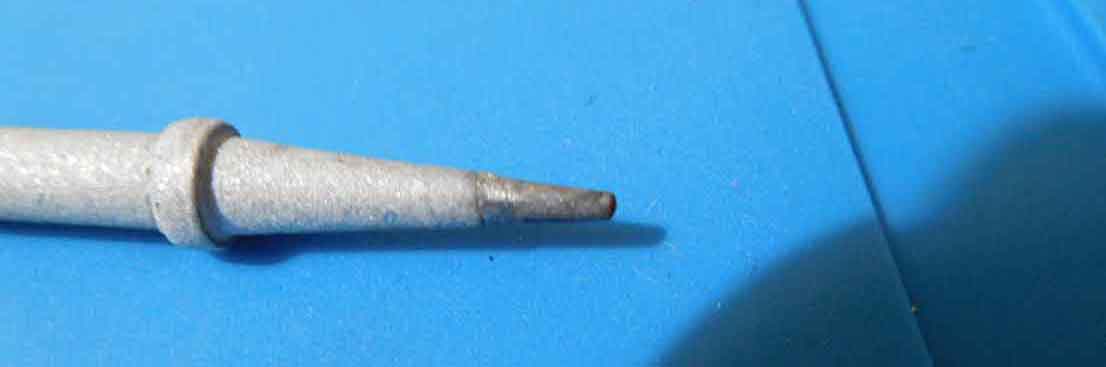
An oxidised tip.
With a decent soldering station you can set the temperature and it will remain around there as the better stations have a thermal sensor to regulate the temperature of the iron, if it drops it supplies more power and if it get too hot, less.
Some will also sense when the iron is not being used and then switch to an “idle” lower setting which will save power as well as tip life.
The budget soldering stations have a similar control but it’s basically more like dimmer switch for a lamp. The higher you turn it the more power and hotter the iron and tip will get. The temperature settings around the dial are really just to indicate what’s happening and not a real guide to the temperature so its a case of not having it set higher then it need to be. Its always tempting just to turn it up a bit more so resist that temptation knowing you’ll just be giving your tips a shorter life span.
You can read here about setting your soldering iron temperature.
Flux
You have to use flux when your soldering. You may not realise if your not using an additional flux paste but your solder will contain a rosin flux core so you are still using it but without realising. You have to have flux to solder.
The oxygen in the air causes metals to form a layer of oxide and this oxide makes a pretty bad solder joint because it stops the solder flowing properly as we want it to.
Flux dissolves the oxide and then fizzes away with the heat from the molten solder. That’s why if you heat a solder joint for too long it looks poor because all the flux has evaporated.
Using flux paste makes soldering a lot easier and you’ll see what a difference flux makes if you do surface mount soldering. Its really difficult to do without using flux paste.
One thing you shouldn’t do which I’ve seen people do is to prod your soldering iron tip into flux. This will cause the tip to corrode so don’t do it.
When you’ve done some soldering using flux, clean you tip right after you’ve done the joints to minimise the time the flux is on the tip.
Tin your tips
You should regularly tin your soldering iron tips and you should always tin new tips before use.
I have an article on tinning a soldering iron here.
I tin it before I finish using it and switch the iron off.
Tips have a coating on them
Years ago soldering iron tips were made of copper but eventually the copper dissolved and got holes or pits in it. It was common practice to take sandpaper or a file to reshape and clean up a copper soldering iron tip, however today’s soldering iron tips have a thin coating of iron plating, so if you clean it with a file or sand it too vigorously you’ll just end up removing the iron plating and leaving bare copper which will dissolve pretty quickly.
You could say that if a tip has got too pitted or has a hole you have nothing to lose by taking a file to it too extend its life but it won’t last long and I just get rid and use a new tip. For me its not worth the hassle.
Soldering iron tip types
There are lots of different types of soldering iron tips. I’ve been soldering for about forty years as a hobbyist and professionally and I’ve only really had to use a few different types.
If you check out Amazon you’ll see some packs with sixteen different types of tips. Some look like the things you on a Swiss army knife that I was always told were for getting stones out of horses hooves!
Some of them look like they have knife blades on the end. I’m told they are for removing solder bridges. I’ve done that with ordinary tips. Some of them have a flat angle on the end.
When I was taught how to solder in my first job as a technician at a university my boss told me that the flat tip was good because you could “carry” more solder on the end of it to a joint. I said I didn’t think you were supposed to “carry” solder to a joint and he said no your not and I’m still confused. I really don’t think you need many different types of tip at all.
Anyway these are about the only soldering iron tips I’ve used to solder everything from surface mount devices to terminals on audio sockets and plugs.
The small soldering iron tip
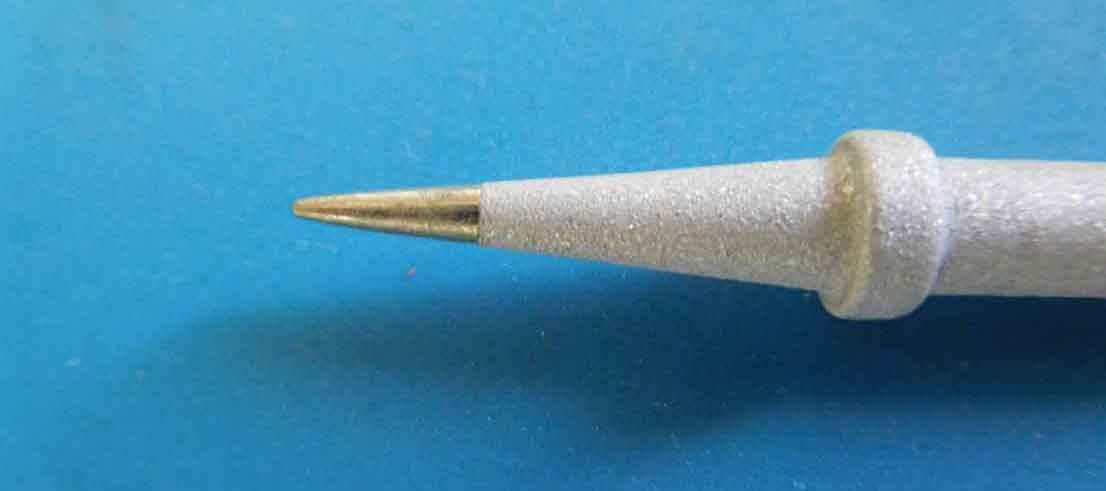
This is the tip that I sometimes use if I have a lot of fine soldering like a small circuit board with lots a tiny pads close to each other. As you can see it goes into a small point so you don’t touch adjacent pads and cause bridges. The small fine point means that its not the best for transferring heat so not so good for larger pads especially plated through holes that connect to large earth plains as they conduct a lot of heat away. I use to use it to solder individual surface mount devices like resistors or capacitors.
The medium soldering iron tip

This is the tip I use for most of my general soldering. As you can see it has a kind or rounded flat on the end. Its large enough to solder all pads and not still not to adjacent ones if your careful.
I also use this tip for soldering surface mount devices like chips with multiple legs. Just use a flux paste and solder the whole lot at once going along. The paste stops the solder from bridging the legs. You might find a blob has bridged a few but more paste and another go soon sorts it out. Once you’ve done it a few times you’ll get used to how much paste to use and how quick to apply the solder and move the iron and you’ll find the whole side soldered perfectly in one go. This tip will also conduct enough heat to solder wires to terminals.
The big soldering iron tip

This is the third tip I use. Its larger and so conduct more heat. I don’t use this for printed circuit boars. This one is just used for soldering wires to terminals. If you have particularly thick wires or a terminal that’s going to conduct lots of heat away you’ll need a tip like this. I also use it for soldering wires to audio plugs. Some of these plug have large areas of metal were the wire connects and small tips struggle so if I’ve lots of audio plugs to solder this tip gets a run out.