
Best soldering irons
I’ve been interested in electronics for about forty years now. Quite I few things have changed but we still need to solder. I’ve been through quite a few soldering irons in my time so I’ll attempt to help guide you into making the perfect purchase so you can get the best soldering iron and not end up with a piece of junk.
Soldering irons explained
Although soldering irons are simple devices, there are a few things that need to be considered when making the correct choice and purchase. It’s a tool that you will keep for a long time if you get the choice right. I have one that is about twenty years old and I still use it now.
Wattage
The first thing that is usually quoted about a soldering iron is the wattage. They vary from around 18 watts up to 50 watts or more. A lot of the “how to solder” articles I’ve read on the internet state you need to get one of at least 35 watts. In my opinion, this is complete rubbish I’ve seen reports that a 20 to 30-watt iron can lose heat quicker than it can reheat itself and it will lead to poor electrical joints.
I’ve used an Antex 18-watt soldering iron for at least five years with no problems at all it’s perfectly hot enough to solder PCBs and terminals on sockets and variable resistors. I can’t remember ever trying to solder anything and finding it wasn’t up to the job, so don’t write it off because of its power rating.
Also, check out my article on soldering temperatures for more information.
Soldering guns
I don’t know why anyone ever thought that making something that soldered into the shape of a gun was a good idea. It’s not as if you going to have to aim it at the joint from twenty yards and pull the trigger to solder!
About as useful as making a pen in the shape of a gun or a gun-shaped screwdriver. Think I’ve made my point, don’t both with a soldering gun.
Don’t bother with the soldering irons that you get in pound shops
My grandma bought me one of these when I had first shown an interest in electronics.
It looked more like one of the things that they used to shoot aliens with in Blake’s 7. Ironic really, they make soldering irons in the shape of a gun and a futuristic space laser look like a soldering iron, anyway, my pound shop soldering iron heated up well enough but the previously tightened tip fell off onto the carpet.
I guess the different metals on the iron had different expansion rates, well that’s what I told my grandma as we watched the pound shop tip burn through the carpet. Not the best soldering iron!
Manufactures pedigree
If you choose something from a company that has been making soldering irons for years, there’s much more chance of being able to get spare parts and new tips. I couldn’t find a replacement tip for my pound shop special after we had extracted it from its carpet crater!
Soldering stations
If you do a lot of soldering you may find a soldering station is more suitable than a soldering iron. With a soldering station, you can alter the temperature and you get a solid base and stand for your soldering needs.
I have more information in my article on soldering stations here.

Choosing a soldering iron
This isn’t going to be one of those guides where someone is listing ten soldering irons they have never seen, never mind used.
I’m not going to list and mention all the poor soldering irons I’ve used. I wouldn’t want to waste your time. Instead here are the two best soldering irons I’ve bought and used and still use.
Antex XS25

Specification-wise, it’s a 25-watt iron weighing 260g with a length of 20cm and is able to heat its tip up to 370 C.
What do want a soldering iron to do? Obviously solder but you’ll also realise you want various other features when you’ve been using an iron for a while.
You want it to be comfortable in your hand and not be too heavy. The Antex XS25 is lightweight, well balanced and feels right. It’s manufactured in England and comes in the standard Antex yellow colour.
There are currently 8 different types and sizes of tips available and a replacement element is also available, manufacturer reference E580060.
Antex XS25 Tips
You don’t have to look very far to find replacement tips for the Antex XS25. It’s worth buying a variation of sizes and I can verify that they are of a high-quality long-life plated iron and will last a long time if you look after them.
Read my guide on soldering iron tips here.
Remember always to tin new tips. Read my guide on tinning soldering iron tips here.
If you check out the Amazon reviews for the iron it gets a very good 4.8 out of 5 with very few people saying anything negative about it. There is however one thing to bear in mind, some have said that the PVC cable is quite heavy and makes the iron sometimes difficult as it tries to pull you in the direction that it wants.
This is something that I can’t say has really bothered me. Mine is used on a bench with a wall-mounted socket in just the right place but I can see how if you had it plugged into an extension or something it might be more of a problem.
The Good Stuff:
- In a word RELIABILITY. Antex has been making soldering irons for a long time.
- This model has been around for years. It’s a successful design so they just keep making it, tips are readily available.
The Bad Stuff:
- The price. There are cheaper soldering irons on the market.
There are different versions of the Antex XS25 available, not only in voltage, which are 12v, 24v and 230v but it is also available with PVC or silicon cables. I can confirm that after using both, the Antex XS25 with silicone the cable is more flexible and less rigid, so if you think this may cause you a problem go for the slightly more expensive silicon cable version.
All in all, I find it difficult to fault the Antex XS25 soldering iron. It was the first proper soldering iron I had. It’s not the cheapest iron you’ll find, but then you can hardly describe it as being expensive either.
I don’t think any of the cheaper irons would have lasted this long but it’s not only lasted it’s still doing the job it was bought for perfectly well and you can still get tips for it and that looks like continuing for a long while. With a little more power than the Antex CS18, It’s the best soldering iron for electronics.
Tip – Buy a decent soldering iron stand
Throw away the metal flat-folded thing you get with your soldering iron and get a proper stand. Antex makes a great one for both of the models here. It’s sturdy and won’t fall over and your iron won’t get pulled out of it like the flat metal ones.
A soldering iron gets very hot and it can cause not only damage to you but your surroundings. Believe me, you won’t be Mr popular if your soldering iron has burnt a table or carpet. Get a proper stand, you’ll thank me later.
Antex CS18

The Antex CS18 is small but powerful.
Like the Antex XS25, the Antex CS18 has been around for quite a few years now and so it has the same advantages that I mentioned in that review here.
It’s made by a renowned manufacturer from England and it’s stood the test of time with replacement parts and tips still readily available. Carry on reading to find out why, in my opinion, this is the best soldering iron for circuit boards.
As you can see from the picture comparing the two soldering irons the Antex CS18 is slightly smaller than the XS25. It’s also slightly lighter.

One of the things you may notice is that the tips look slightly different to how they used to be. They originally used to have a small slot down the end on both sides and have a sprung clip to retain the tip on the shaft.
They have now done away with the slots and the tips are now smooth all around. The retention now takes place internally to the tip with a thin metal shim that grips the shaft. The new improved tips are now claimed to be longer in life and with better heat transfer.
Strangely there doesn’t seem to be as much discussion among users about the cable. On the XS25 some people didn’t like the PVC cable version because they mentioned the rigidity of the material made the soldering iron difficult to handle. With the Antex CS18 being smaller and lighter this ought to be more of a problem. I did, however, buy the silicon cable version on this because of the added flexibility on a smaller iron. I consider this to be worth the small extra cost.
Antex CS18 tips
As I’ve mentioned the bits are widely available and there are 9 different varieties. They are known as the 1100 range and they cover the numbers 1100-1109. The range is shared with the TCS and TC50 models. The 2.3-millimetre tip is supplied with the iron.
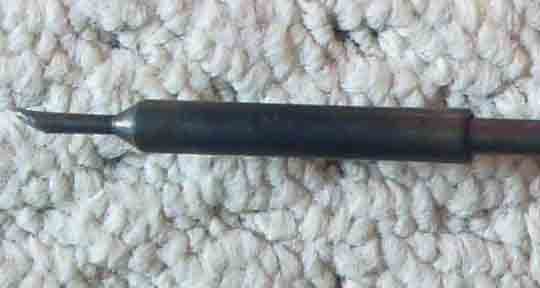
Although this is only an 18-watt soldering iron I have found it almost perfect for general soldering on electronic projects. It is great not only for soldering PCBs but I’ve also used it for soldering wires onto terminals. I’ve also successfully used it for soldering cables onto sockets.
It will even solder the shielded cables onto large plug terminals without any problems. I think this has to do with Antex knowing how to design soldering irons that can transfer heat effectively and efficiently without having to just opt for a large powerful element like some lesser manufacturers have.
It’s available in 12V, 24V and 230V versions and specifications say that it heats to a temperature of 390C.
This isn’t the cheapest iron you can buy but you’ll get years of reliable service and an excellent soldering iron. I think this is the best soldering iron for circuit boards that you can buy.
The Good Stuff:
- Manufactured in the UK. Reliable company that has made soldering irons for ages.
- Made for years with improvements making it even better. The latest is longer life tips with improved heat transfer.
The Bad Stuff:
- The price again, similar comment about the XS25, there are cheaper models out there.
Best soldering irons – Final Words
I’ve bought and owned both the Antex XS25 and the Antex CS18 and used them both for a long time. All I’ve done is buy replacement tips. Both have been around for a long while and the only change has been improved tips with a new design and with better heat transfer.
There are cheaper soldering irons but if you’re going to be using it for any length of time I think the cost pales into insignificance. I’ve had mine for years and years. I can’t imagine how many hours use, or how many things I’ve built with them. It does make me wonder how many solder joints they’ve done!
Getting a good soldering iron will help you to solder but nothing beats learning how to solder properly. It’s worth a read even if you know how to solder as it contains lots of tips to make things easier.
It’s also worth knowing about the different kinds of solder and what’s the best for building electronic projects.
I’ve also found a few tools that really help when it comes to soldering. There are some that I now would be without.

“Hi, I’m Graham Moore and I’ve been building electronic projects since I was 12. I had a fascination for old radios and taking them to pieces but when my Nan bought me an electric soldering iron, I realised with a few components I could build stuff.
Learning to solder opened up many doors for me as electronics also became a career. I hope you get as much from it as i did”.