

Wires for breadboards
What wire do I use for solderless breadboards?
Let’s start with what not to use. Don’t use stranded wires for breadboards.
Stranded wires
They will be difficult to push into the breadboard as the stranded wire isn’t physically strong enough. Even if you get the stranded wire to go into the breadboard you may get a rouge strand that could short onto other wires or components next to it. You can damage the breadboard if some of the strands break off and get stuck in the breadboard.


Even if you solder the strands together the wire will still be too flimsy where it joins the plastic insulation. The tinning can make the end a lot thicker causing the breadboard connections to bend slightly. You’ll notice this when you try to use components with thin leads like 1N4148 diodes. Just don’t use it, OK.
Information
The modern plastic breadboard in use today, with .1-inch spacing holes was patented in 1971 by Ronald Portugal.
Wires for breadboards – Solid core wire

This is OK to use, it is what it says on the tin and that is a plastic insulated wire with a solid copper core. It comes in various thicknesses which used to be known as the standard wire gauge or SWG or American wire gauge or AWG.
These days it’s more common to see it listed as the diameter of the solid copper in mm. For use in a breadboard, you don’t want it too thin or it will bend and not go into the holes and you don’t want it too thick that it won’t go into the breadboard. Worse still is that too thick wire can damage it.
You should be looking for something like 22 AWG or 0.64mm.
I commonly use solid copper wire that measures 0.53mm. This plugs into the breadboard sockets easily and it’s also easy to bend.
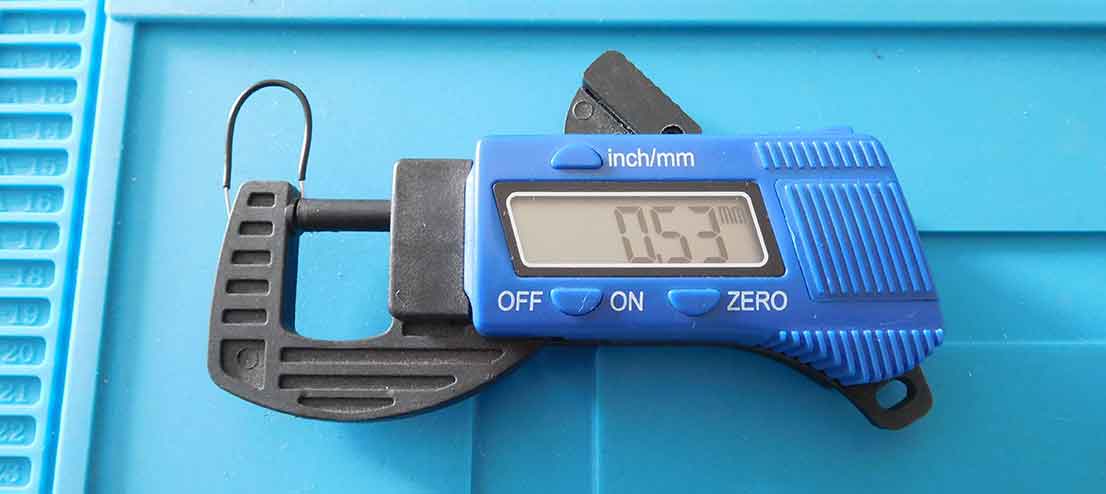
This is another use of my digital micrometre to measure the wire thickness. I’m no longer stuck when the label has come off.
It is pretty cheap and comes in all colours so you can make your breadboard wiring easy or should I say easier to follow and you can cut it to the lengths you need. You’ll obviously need to strip it but with a decent automatic wire stripper this is hardly a chore,.
Wires for breadboards – Bare copper wire
If you have a short connection between a couple of holes or a straight connection of three or four holes you can use tinned copper wire. This comes in rolls again there are various thicknesses that you looking for. A time saving advantage of this type of wire is that it doesn’t have to be stripped and as it’s so cheap you can just cut it to length and throw the bits away after you’ve finished.

One tip when cutting it for breadboard connections is the cut it at an angle. The point you’ve just created makes it extremely easy to push into a breadboard socket.

I use a couple of sizes the thin measures as 0.54mm which is about 24 AWG.
The thicker one measures 0.66mm which is about 22 AWG.
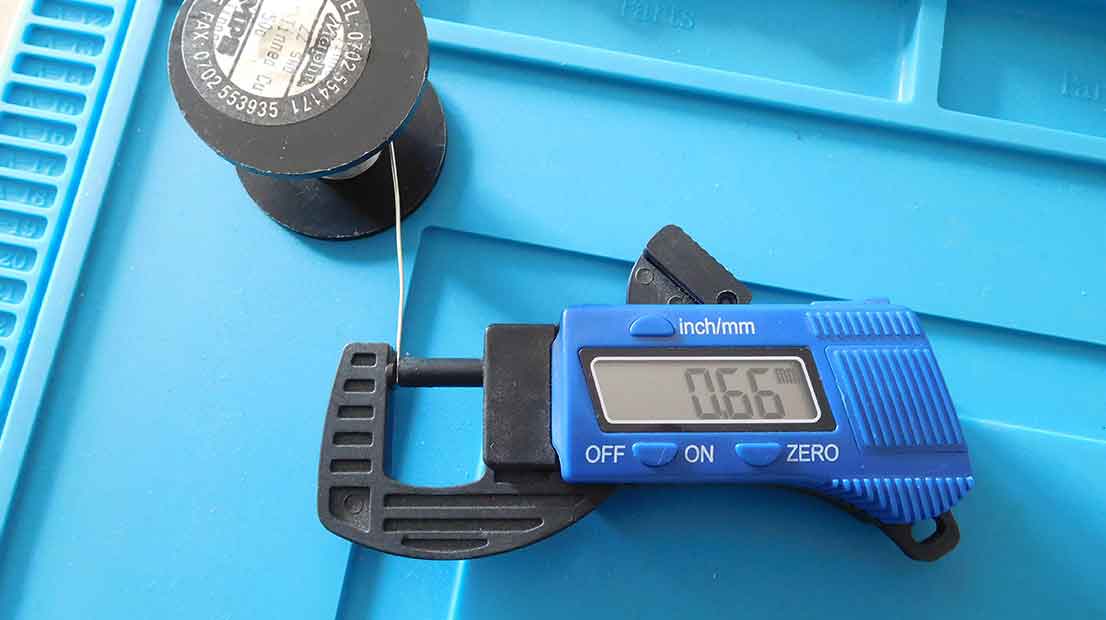
Be careful when you use it as it’s uninsulated and you don’t want to short it to another connection and don’t be tempted to use it for long connections for the same reason.
Wires for breadboards – Male-to-male jumpers

Although these are the most expensive options there’s something quite nice about using them. They are a bit like using patch cables as they have a nice solid end to them with the protruding connection.
Usefully they are very easy to plug in and take out.
They also come in various colours but because of the connectors, you are stuck with the lengths you have. This is what I mainly use for my wires for breadboards for longer connections.
Colour coding
Once you start breadboarding more complex circuits the wiring can start to look a bit like a rat’s nest. Trying to find a particular connection can be rather hard. To make it easier I stick to colour coding. I use black leads for everything that goes to the negative connection and red for everything that goes to the positive. I then use the other colours depending on the circuit I’m building which will vary if it’s an audio circuit, digital logic or something else. You can work out what’s best for you.
Wires for breadboards – Final thoughts
The best way to use wires for breadboards is to use a combination of tinned copper wire for very short connections in straight lines and male-to-male jumper cables for longer connections. You can use the jumper cables throughout but it can get a bit messy and complicated. Using tinned copper wire for short connections helps in keeping things tidier.
Also check out my post, Breadboards – the complete guide, for everything you need to know about breadboards.


“Hi, I’m Graham Moore and I’ve been building electronic projects since I was 12. I had a fascination for old radios and taking them to pieces but when my Nan bought me an electric soldering iron, I realised with a few components I could build stuff.
Learning to solder opened up many doors for me as electronics also became a career. I hope you get as much from it as i did”.
Breadboard design software

Breadboard design software tested and compared If you use breadboards, you might find breadboard design software helps with your building. Breadboards are tremendously useful for beginners who can’t solder…
Breadboard tips

Breadboard tips I learnt to use breadboards in a sort of trial-and-error method. There doesn’t seem to be much in the way of instructions on how to use a breadboard….
How are breadboards connected?

How are breadboards connected? Breadboards vary in type so how they are connected depends on the type of breadboard. Breadboards can be further divided into two main types and that’s…
How to build a circuit on a breadboard

How to build a circuit on a breadboard The advice here assumes that you are looking at how to build a circuit on a breadboard by working from a circuit…
How do breadboards work?

How do breadboards work? Before you can answer the question how do breadboards work, you need to know exactly what a breadboard is. Firstly, there are various types of breadboards…