

What is a capacitor and how does it work?
What is a capacitor?
To know what is a capacitor and how does it work, let us start with what it is. A capacitor is an electronic component that stores an electric charge.
It is a passive component and the oldest electronic component thought to have originated around 1740. How much electric charge a capacitor can store or its capacity, depends on the value of the capacitor.
Capacitors are measured in units called Farads but a Farad is very large when it comes to measuring, so smaller units of microfarads are used.
A micro Farad is a millionth of a Farad and is also known by the symbol uF.
Next down is nano Farad, which is a thousandth of a uF and is also known by the symbol nF.
Next down is a pico Farad, which is a thousandth of an nF and is also known by the symbol pF.
So 1,000pF is the same as 1nF which is also the same as 0.001uF. You get used to converting between them by moving the decimal point by 3 places. Capacitors vary hugely in value.
I’ve recently built a circuit that uses 15pF capacitors with a timing crystal and 4700uF capacitors in the power supply.
What is a capacitor used for?
Capacitors are used in power supply circuits to smooth the voltage. If you connect a circuit to mains alternating current or AC, once it’s converted to direct current or DC it will be a very uneven voltage. A large value capacitor connected across this varying, uneven voltage will smooth it out so that it’s nearly flat. After all, that’s what you want in a power supply, a DC supply that remains at the voltage you want, 12 volts for instance. If you’re powering an audio circuit and the supply isn’t adequately smoothed you can often hear the 50Hz mains AC as a low buzz.
Timing circuits also use capacitors as they take time to charge. The bigger the value the longer, so used in conjunction with a resistor you can easily get any time you want.
They are also used in audio circuits like filters as they can allow AC signals to flow but block DC signals.
How does a capacitor work?
A capacitor stores an electric charge, it consists of two conducting surfaces separated by an insulator. They were discovered by accident when someone in a lab had a jar with a nail in a cork and some water. This became known as a Leyden jar which was the first capacitor.
When a battery is connected to a capacitor, the charge flows to the plates of the capacitor, one positive and one negative. The current is at first limited only by the resistance of the wire, but as more charge builds up, charge repulsion starts to resist the flow and the current flow is reduced until the charge repulsion is large enough to stop the current flow completely. This is when the capacitor’s plate voltage is the same as the battery’s.
What is a capacitor and how does it work – Types of capacitor
Capacitors are usually called by whatever the insulating plates are made out of. This is also known as the dielectric. They can be further split into types, polarised and non-polarised.
Polarised capacitors
There are many types of capacitors but they can be divided into polarised and non-polarised. A polarised capacitor is marked with a positive and a negative. They have to be connected up correctly and if they aren’t they can explode. I can confirm this as I once soldered a polarised electrolytic capacitor in the wrong way around. Shortly after powering up the circuit, there was a bang and the air filled with a strange smoke and something like a fluff trail. Following the trail lead to half a capacitor. The printed circuit board which it was soldered to had snapped in half!
Electrolytic capacitors
Polarised capacitors are usually larger-value capacitors. As the values go up above 1uF they are usually polarised and made of electrolytic. They are usually can-shaped and the bigger the value the bigger the size. If the leads come out of either end of the can they are called axial.
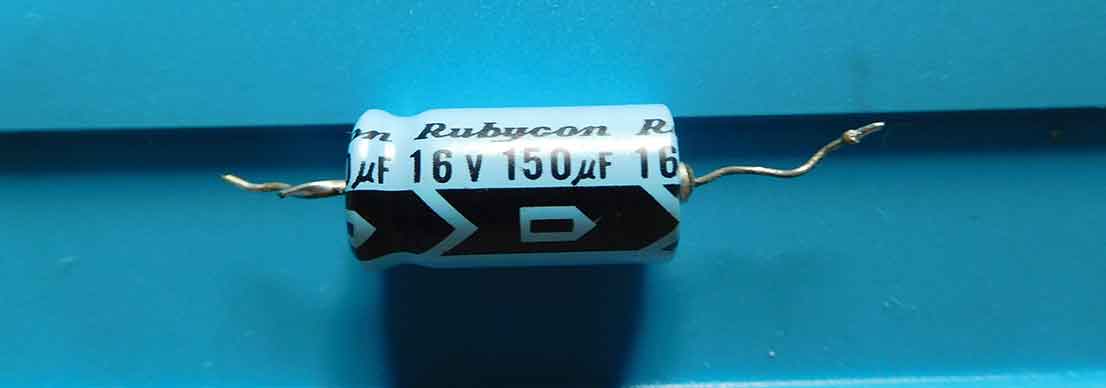
If both leads come out of the same end they are called radial. Radial capacitors are easier to printed circuit mount and they take up less space on a printed circuit board.

Years ago electrolytic capacitors used to be huge but an equivalent made today is a lot smaller. They are large enough to have their value and working voltage printed on the side. The working voltage is a maximum so don’t go using 4.7-volt capacitors in a 12-volt circuit!
Tantalum bead capacitors
The next most common polarised capacitor is the tantalum bead variety. They are small and light when compared to other similar value capacitors and they are also very stable, so are often used in filter circuits. The downside is that compared to other capacitors, they are more expensive.
What is a capacitor and how does it work – Non-polarised capacitors
Non-polarised electrolytic capacitors
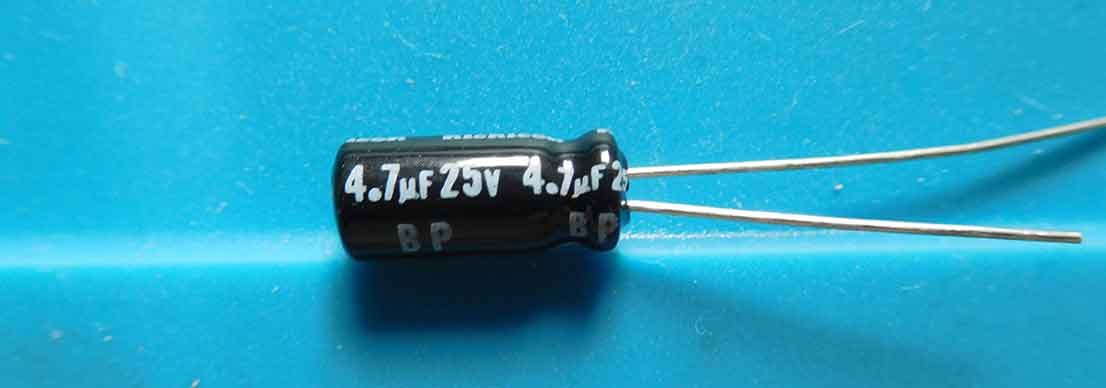
You can also get electrolytic capacitors of 1uF and upwards that are non-polarised but look just like their polarised cousins. I recently used some in a synthesizer filter circuit that was 4.7uF. They are used when a reverse polarity across the capacitor can occur. This would obviously cause problems with a polarised capacitor. They aren’t all that common and were also quite hard to get hold of.
Ceramic capacitors

The ceramic capacitor is very popular and you’ll find it hard to find a PCB that doesn’t have any of them. Ceramic capacitors are generally non-polarised and they aren’t very linear with temperature changes and are not the most stable capacitors either. They are very cheap though and are very small for their capacitance. They are the lowest quality capacitors and are often disk-shaped and used in non-critical things like decoupling. As they are so small you can’t fit much writing on them and still be able to read them so their values are usually a three-digit code. The capacitors you see in pairs next to ICs are usually ceramic and their job is to decouple the power supply lines.
Polystyrene film capacitors
Polystyrene film capacitors have a polystyrene dielectric. These are more expensive and more stable than ceramic capacitors. As they are tubular the plates are rolled which creates an inductance and this limits their frequency response. They start at low values of a few pF and go up to about 50nF. They are often used in timing circuits.
Polyester film capacitors
These capacitors are fairly cheap and offer larger values than ceramic film capacitors. Plastic films of various types have replaced the old paper capacitors and polyester film capacitors are used as general-purpose capacitors used in many applications.

Polycarbonate capacitors
These capacitors have good temperature stability but the values have quite a high tolerance, up to 10 per cent so they aren’t that great for high precision applications but they do have high working voltages up to about 400 volts.
Silver mica capacitors
These capacitors have a thin layer of silver on their mica dielectric and can be manufactured very close to their desired value, they are also very stable and don’t get too affected by temperature changes. This makes them a very good choice for filter circuits. Unfortunately, they are expensive and can only be made to relatively low capacitance values.
Motor capacitors
You may also come across some specialist capacitors that are for use in electrical appliances. It’s quite common for motors to use capacitors. They are mainly used to start the motor. A motor uses less power when it’s running and more to start it up. A capacitor is used to give the motor the extra power boost it needs to start.
They are also used in air conditioning units where you sometimes find a dual capacitor.
For more information, you can read here about air conditioning unit capacitors.
Variable capacitors
A variable capacitor is rather unsurprisingly a capacitor whose value can be varied. They are usually very small values and go from zero or there about to something like 500pF. They used to be quite common components years ago. Their main use was in radios where they were used to tune it to the frequency you wanted. Some of the older ones were quite large and had a few different taps on the capacitor with different values on the same device, all controlled with the same spindle and control knob. I can remember using them to make basic radios when I first started in electronic construction.
The demise of the analogue radio has also seen the demise of the variable capacitor.
Trimmer capacitors
A trimmer capacitor is a small variable capacitor that can have its value adjusted with a small trimming tool or screwdriver. Like the variable capacitor, the are very small values. So small that if you use a metallic tool like a screwdriver to adjust them you can affect the capacitance. This is why the non-metallic trimmer tools are used to adjust them.
Capacitors in series and parallel
Capacitors can be connected in series and parallel just like resistors can however they are exactly opposite to them in terms of the result. If you connect two resistors in series with one another the total resistance is the sum of the two. If you want to get the sum of two capacitors you connect them in parallel with each other.
Two resistors of the same value in parallel half the value of the resistance. To half the value of two similar value capacitors, you connect them in series with each other.
What is a capacitor and how does it work – Capacitor colour codes
Years ago some capacitors used to be colour-coded. The colours were the same as the resistor colour code.
The resistor colour code is explained in this article.
On a capacitor, the colours were read downwards from the top of the capacitor. The first digit, the second digit and then the multiplier. If there were any further colours they were for tolerance and voltage but these were not always present.

Capacitors are no longer colour-coded but you still might find some older ones that use it.
Capacitor numerical codes
What is commonly used now though is a three-digit numerical code. It is used mainly on ceramic capacitors because of their small size. You can just about fit three digits on a ceramic capacitor.
| Code | pF | nF | uF | Code | pF | nF | uF |
|---|---|---|---|---|---|---|---|
| 100 | 10 | 0.01 | 0.00001 | 472 | 4700 | 4.7 | 0.0047 |
| 150 | 15 | 0.015 | 0.000015 | 502 | 5000 | 5.0 | 0.005 |
| 220 | 22 | 0.022 | 0.000022 | 562 | 5600 | 5.6 | 0.0056 |
| 330 | 33 | 0.033 | 0.000033 | 682 | 6800 | 6.8 | 0.0068 |
| 470 | 47 | 0.047 | 0.000047 | 103 | 10000 | 10 | 0.01 |
| 101 | 100 | 0.1 | 0.0001 | 153 | 15000 | 15 | .015 |
| 121 | 120 | 0.12 | 0.00012 | 223 | 22000 | 22 | .022 |
| 131 | 130 | 0.13 | 0.00013 | 333 | 33000 | 33 | .033 |
| 151 | 150 | 0.15 | 0.00015 | 473 | 47000 | 47 | .047 |
| 181 | 180 | 0.18 | 0.00018 | 683 | 68000 | 68 | .068 |
| 221 | 220 | 0.22 | 0.00022 | 104 | 100000 | 100 | .1 |
| 331 | 330 | 0.33 | 0.00033 | 154 | 150000 | 150 | .15 |
| 471 | 470 | 0.47 | 0.00047 | 204 | 200000 | 200 | .2 |
| 561 | 560 | 0.56 | 0.00056 | 224 | 220000 | 220 | .22 |
| 681 | 680 | 0.68 | 0.00068 | 334 | 330000 | 330 | .33 |
| 751 | 750 | 0.75 | 0.00075 | 474 | 470000 | 470 | .47 |
| 821 | 820 | 0.82 | 0.00082 | 684 | 680000 | 680 | .68 |
| 102 | 1000 | 1.0 | 0.001 | 105 | 1000000 | 1000 | 1.0 |
| 152 | 1500 | 1.5 | 0.0015 | 155 | 1500000 | 1500 | 1.5 |
| 202 | 2000 | 2.0 | 0.002 | 205 | 2000000 | 2000 | 2.0 |
| 222 | 2200 | 2.2 | 0.0022 | 225 | 2200000 | 2200 | 2.2 |
| 332 | 3300 | 3.3 | 0.0033 | 335 | 3300000 | 3300 | 3.3 |
What is a capacitor and how does it work – Conclusion
Capacitors are extremely useful and versatile components. You would be pushed to find a printed circuit board or circuit diagram that didn’t contain any of them.
I have a related article here about How to test a capacitor and a more general one about testing electronic components.