

How to test a MOSFET transistor
I’m going to start with the easiest way to test a MOSFET transistor. You will need to have the device out of circuit so if it’s on a PCB and you’re not sure about de-soldering I have a detailed guide here.
It’s the easiest way because you:-
1. You don’t need to know what type of MOSFET you have (N channel, P channel, enhanced or depleted)
2. You don’t need to know the pin out of the device you’re testing.
3. You don’t need to do the sometimes fiddly procedure of holding the device and test probes onto various pins while trying to read the multimeter. Then wondering if you had the probe on the correct leg.
4. It’s a lot quicker, especially if you have a few to test.

Using this component tester you put the component in the socket throw the lever to connect it up and press the one button. If you want to know more about these component testers I have an article here.

As you can see from the image above the device on test is an N channel enhancement mode MOSFET with the pin out reading from left to right, gate, drain and source.
I don’t know why people obsess with using a multimeter for testing everything. Sometimes it’s just not that suited. This component tester is cheaper than a multimeter! Some people may think you learn more by using a multimeter but once you’ve taken the time to find what type of device you’ve got and then the pin out and then done the multimeter tests you could have used that time to educate yourself about something else. However if you need to test it a multimeter here you go.
How to test a MOSFET transistor with a multimeter
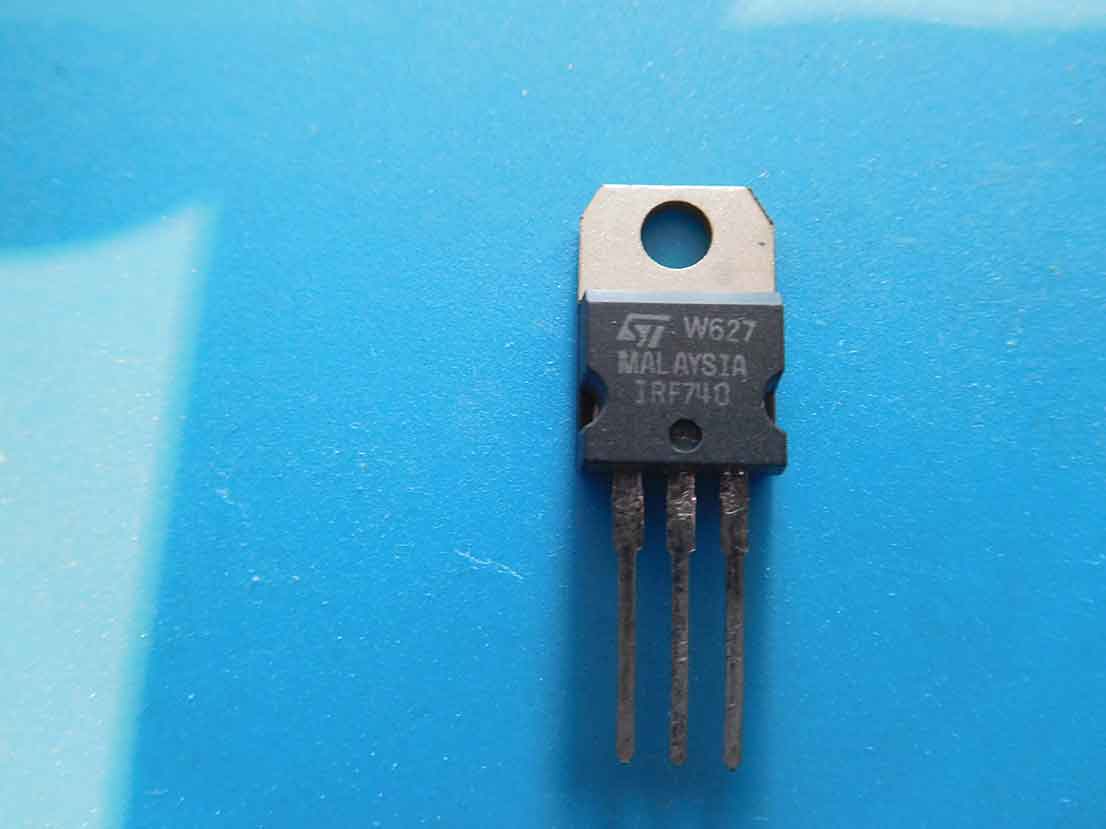
The device is an IRF740.
This is how to test an N channel, enhancement mode MOSFET with a multimeter using the diode test setting on the multimeter. First you’re going to need to know the pin out of the device, luckily this will be easy to find on the internet.
Next short together all three legs of the MOSFET with a component lead off cut or uninsulated piece of wire.

Or use the probe of the multimeter, make sure you touch all three terminals.
Once you have identified which are the drain, gate and source, connect the black negative lead of the multimeter to the source and the red positive lead to the drain.

You should have no conduction here indicated on the multimeter.
Disconnect the red positive lead and connect it to the other leg which will be the gate.

Then disconnect the red positive lead from the gate and back to the drain.
This time the multimeter should indicate a very low resistance with probably an audio beeping sound if that’s what your multimeter does.

Now if you have a small piece of uninsulated wire like an off cut from a component, short the other two leads that aren’t connected to the red positive lead, that’s the gate and source.
When the gate and the source are connected momentarily it effectively turns the switch back to “off” and no conduction should now be indicated on the multimeter.
You can also test a P channel, enhancement mode by doing the same tests as above but reversing the polarity of the multimeter leads.
These tests will help you identify a failed MOSFET in a lot of situations however it isn’t totally definitive that’s why I much prefer the first method of using the component tester. You just plug it in and press test.
There are some other tests that you can do with a multimeter but they involve connecting the MOSFET to a power supply and a simple circuit but to be honest what’s the point. If you’re going to go to that trouble you may as well go and get a component tester.
What is a MOSFET transistor and how does it work
A MOSFET is a metal oxide semiconductor field effect transistor. Whereas a transistor has a base, collector and emitter, a MOSFET transistor has a drain, gate and source. In its simplest explanation you can control the voltage and current flow from the source to the drain by applying a signal to the gate.
Again simplifying things you can get depletion mode MOSFET’s and enhancement mode MOSFET’s.
Think of an enhancement mode MOSFET as a normally open switch. There is no conductivity between the source and the drain, when the gate gets a signal there is conductivity between the source and the drain.
Think of a depletion mode MOSFET as a normally closed switch. There is maximum conductivity between the source and the drain, when the gate gets a signal the conductivity decreases. MOSFETs also come in n channel and p channels as well as enhanced or depletion so that’s four common types.
What is a MOSFET transistor used for?
A MOSFET transistor is used for switching and amplification they are used in a huge number of electronic circuits and applications they are particularly good in power controlling circuits so are used a lot in power supplies and in things where power is switched like dimmer switches and the like they are also used a lot in high power audio amplifiers.
What is the difference between a transistor and a MOSFET?
A transistor is a semiconductor device it has 3 terminals or legs, a base, a collector and an emitter. They can be NPN or PNP if you want more detail you can read here. A MOSFET similarly comes as an N channel and P channel device.
Without getting too complicated, a transistor is controlled by current and a MOSFET is controlled by voltage
What are the advantages of a MOSFET?
Again put simply the advantages a MOSFET have over a transistor are they can switch faster and so have a better frequency response, they have a high input resistance and impedance and they can be used for higher current and power applications than a typical transistor they also use less power than a transistor however they are usually more expensive than transistors and they are more sensitive to getting damaged from static electricity.
If you need information about JFET’s, including testing you can read more here.